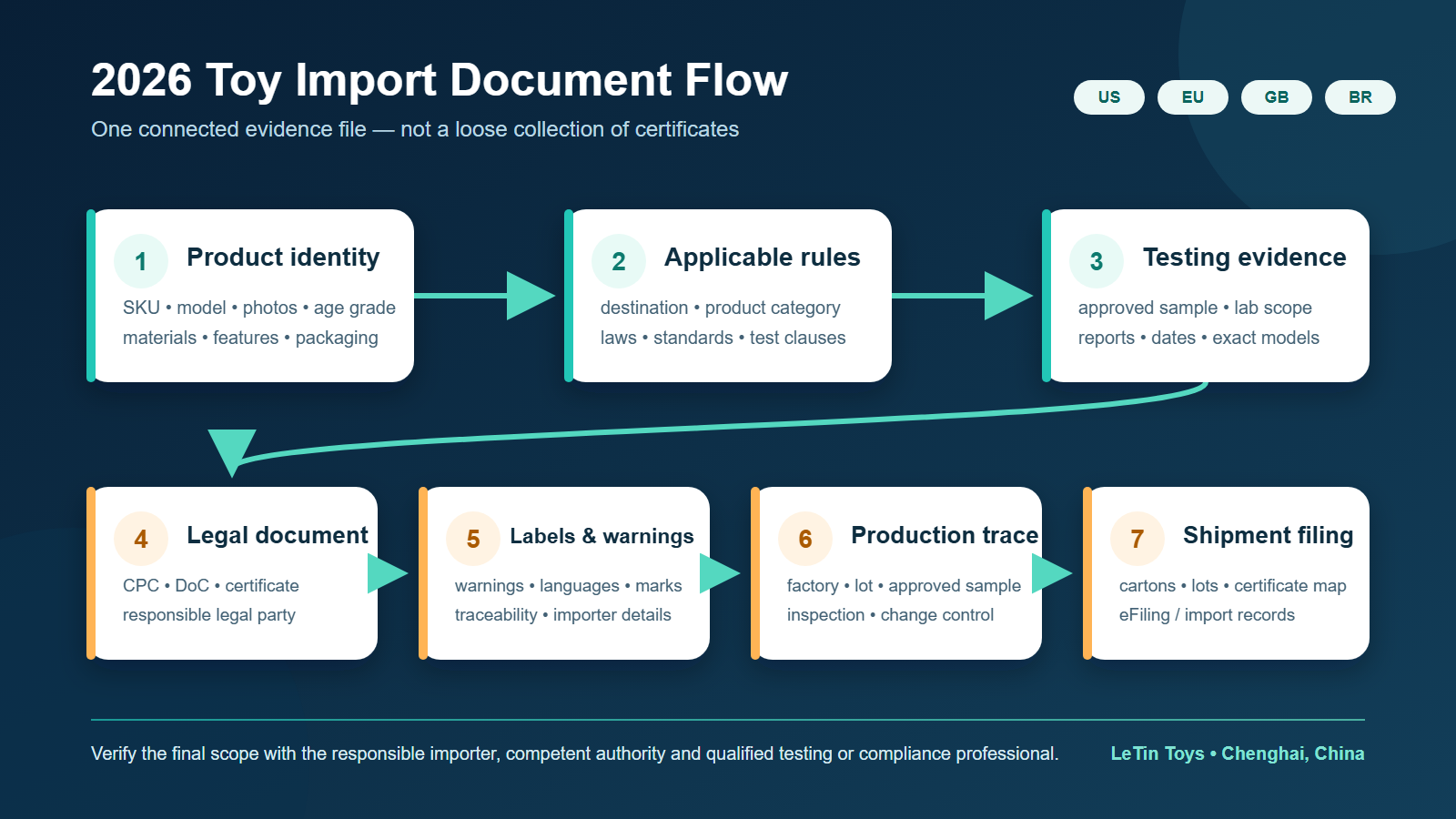
A compliant toy shipment rests on a 10-document master file — a connected evidence chain in which the product, age grade, test report, declaration or certificate, labels and shipment records all refer to the same model. This checklist shows importers, distributors and sourcing teams exactly which documents to request before mass production and before shipment, for the US, EU, Great Britain and Brazil.
Importing a toy is not only a matter of ordering a test report. A shipment normally needs a connected evidence file: the exact product and age grade, the rules that apply, test evidence, the correct declaration or certificate, traceable labels, and shipment records that all refer to the same model.
This checklist helps importers, distributors and sourcing teams identify the documents to request before mass production and before shipment. Requirements vary by product design, age grading, materials, features and destination. Confirm the final scope with the responsible importer, a qualified compliance professional and the relevant authority.
Download the 2026 Toy Import Compliance Checklist (PDF)
Contents
- The 10-document master file
- United States checklist
- European Union checklist
- Great Britain checklist
- Brazil checklist
- What a sourcing partner can and cannot do
- Quick pre-shipment sign-off
- Frequently asked questions
The 10-document master file
Start with one controlled folder for each product or product family. Do not mix evidence from visually similar toys unless the certificate or report clearly covers every model.
Want a supplier who assembles this document file with your order instead of after it? Send your product list — quote and documentation status within 1 business day. Request a free quote →
| Document | What it should identify | Usually prepared or controlled by |
|---|---|---|
| 1. Product identity sheet | SKU/model, photos, intended use, age grade, dimensions, power source, accessories and packaging | Brand/importer with supplier data |
| 2. Product-family map | Which colours, sizes and variants are covered by which evidence | Brand/importer, supplier and lab |
| 3. Bill of materials and critical components | Plastics, coatings, batteries, magnets, cords, liquids and other safety-relevant parts | Manufacturer/supplier |
| 4. Applicable-rules matrix | Destination, product category, laws, standards and test clauses | Responsible business with competent adviser/lab |
| 5. Test plan and reports | Exact tested sample, model, age grade, clauses, result, lab identity and report date | Qualified or accepted laboratory where required |
| 6. Legal declaration or certificate | Product identity, applicable rules, responsible legal entity and supporting evidence | Party legally responsible in the destination market |
| 7. Label and instruction pack | Age grading, warnings, traceability, economic-operator details, language and markings | Brand/importer with supplier artwork |
| 8. Production and lot file | Factory, dates, batch/lot, inspection records and approved sample | Manufacturer/supplier and buyer QC team |
| 9. Shipment evidence map | Purchase order, carton marks, lot numbers and the certificate/report tied to the shipment | Importer, supplier and forwarder/broker |
| 10. Change-control log | Material, component, colour, supplier, tooling, packaging or label changes after testing | Brand/importer and supplier |
The common failure is not simply “no report.” It is a mismatch: the report names one model, the carton shows another, the tested age grade differs from the retail label, or a critical component changes after testing.
United States checklist
Core documents
- Product identity and intended age group.
- A list of the CPSC rules and individual ASTM F963 sections that apply to the toy.
- Third-party test reports from a CPSC-accepted laboratory for covered toys designed or intended primarily for children 12 and under, subject to applicable rules and valid exceptions.
- A Children’s Product Certificate (CPC) for a covered children’s product.
- Tracking-label artwork and production information for the product and packaging.
- Required warnings, instructions and other product-specific labels.
- Certificate data prepared for CPSC eFiling where the imported product is subject to certification.
- A shipment-to-certificate map showing which certificate covers each entry and product lot.
ASTM F963-23 is the mandatory toy standard version for covered toys manufactured after 20 April 2024. ASTM F963 covers toys for children under 14, while CPSC third-party testing and CPC requirements apply to products designed or intended primarily for children 12 and under. The applicable sections are product-specific. See the CPSC Toy Safety Business Guidance and ASTM F963 requirements chart.
The CPC is issued by the responsible US domestic manufacturer or importer based on supporting test results; the testing laboratory does not issue the CPC. The CPSC provides an official toy CPC example.
As of 8 July 2026, importers of products subject to CPSC certification requirements must electronically file certificate data before the products enter US commerce. Foreign Trade Zone entries have a separate effective date of 8 January 2027. Confirm roles in the CPSC certificate guidance and eFiling resources for importers.
Before shipment, verify
- The model, photos and age grade on the test report match the retail product.
- The CPC lists the correct responsible US entity, rules, manufacturing location/date, testing location/date and laboratory.
- Tracking information appears on product and packaging as required.
- The importer or its authorised filing party has the certificate data needed for eFiling.
- Battery, magnet, projectile, aquatic, ride-on, art-material or other special features have been assessed separately.
For wider purchasing context, see LeTin Toys’ wholesale toys USA import guide.
European Union checklist for products placed on the market in 2026
Core documents
- Product description, intended use and age grading.
- Safety assessment and applicable-requirements matrix.
- Technical documentation covering design, manufacture, risks, standards, reports and critical materials/components.
- Test evidence appropriate to the product and applicable requirements.
- EC/EU Declaration of Conformity for the finished toy.
- CE-mark artwork and placement.
- Type, batch, serial or other traceability identification.
- Manufacturer and EU importer/economic-operator contact details as applicable.
- Instructions, safety information and warnings in the language(s) required by the destination country.
- A controlled file retained and updated for the required period.
Under the current toy framework, importers must ensure that the manufacturer carried out the appropriate conformity assessment, prepared technical documentation, placed the required marking on the toy and supplied the required documents. The importer must also provide its identifying and contact information. See Directive 2009/48/EC, Article 6 and the European Commission’s placing toys on the EU market guidance.
CE marking is not a certificate purchased from a central EU body. It is the manufacturer’s declaration that the product complies with applicable requirements, supported by the conformity assessment, Declaration of Conformity and technical file. See the official CE marking guidance.
Important 2026 transition note
Regulation (EU) 2025/2509 entered into force, but most provisions—including the main digital product passport framework—apply from 1 August 2030. Only Articles 28–44 and 49–55 apply from 1 January 2026. Do not tell a 2026 buyer that every toy already requires a digital product passport. Check Article 59 of Regulation (EU) 2025/2509 for application dates.
Before shipment, verify
- The Declaration of Conformity covers the finished toy, not only a component.
- The technical file and reports use the same model identity and current construction.
- CE, age grading, warnings and economic-operator details are placed correctly.
- Required languages match every EU country where the product will be sold.
- Product or material changes trigger a documented compliance review.
For sourcing context, see the Germany and EU wholesale toy import guide.
Great Britain checklist
This section covers England, Scotland and Wales. Northern Ireland follows a different framework.
Core documents
- Product identity, age grading and safety assessment.
- Applicable conformity-assessment record.
- Technical documentation and supporting test evidence.
- UK Declaration of Conformity for UKCA-marked toys, or EU Declaration of Conformity for CE-marked toys.
- CE or UKCA marking, as applicable to the chosen route.
- Manufacturer and Great Britain importer identification and postal address.
- Type, batch, serial or model identification.
- English instructions, warnings and safety information.
- Records for sample testing, complaints, non-compliant products, withdrawals and recalls.
- Declaration and technical-document retention for 10 years.
Great Britain continues to recognise CE marking indefinitely for toys, so businesses can use CE or UKCA when the relevant route and requirements are met. Importers must check the manufacturer’s conformity procedure and technical documentation, provide importer details, protect compliance during storage and transport, keep the declaration, and make the technical file available for 10 years. See the UK government’s Toys (Safety) Regulations 2011 guidance for Great Britain.
Before shipment, verify
- The marking and Declaration of Conformity use the same legal route.
- The GB importer’s required details are present in an allowed location.
- The file does not confuse Great Britain with Northern Ireland.
- Warnings and instructions are legible, accurate and in English.
- The importer can access the declaration and technical documents for the full retention period.
For country-specific buying context, see the UK wholesale toy import guide.
Brazil checklist
Core documents
- Product scope/classification and intended age range.
- Brand, model, technical description and product photos.
- Certification plan with an accredited Product Certification Body (OCP).
- Test and conformity evidence required by the selected certification route.
- Certificate of conformity and INMETRO product registration where required.
- The correct import licence/LPCO and INMETRO consent documents for the route.
- INMETRO conformity seal with registration number, placed according to the rule.
- Portuguese product information, age grading, instructions and risk warnings.
- Manufacturing-date identification and other required permanent markings.
INMETRO Ordinance 302/2021 establishes compulsory toy certification and registration for sale in Brazil. See INMETRO’s summary of Ordinance 302/2021.
The conformity seal must be visible, clear, indelible and tamper-resistant on the label or packaging, with special placement rules for bulk or unpackaged toys. See INMETRO seal placement guidance and mandatory marking guidance.
Import procedures depend on the product and certification model. Confirm the correct LPCO and attachments rather than assuming one route covers every shipment. See INMETRO’s types of importation guidance.
Before shipment, verify
- The certificate, registration and import documents use the same brand/model identity.
- The OCP confirms the correct certification model and sample plan.
- The seal and registration number are placed correctly.
- Age grading, warnings, instructions and commercial information are in Portuguese.
- The importer confirms the current LPCO/import-consent procedure before loading.
For wider sourcing context, see the Brazil wholesale toy import guide.
What a China toy sourcing partner can—and cannot—do
A China toy sourcing partner can help collect product specifications, factory records, critical-component information, approved samples, label artwork, inspection results, test reports and shipment-to-model mapping. It can coordinate with the buyer’s selected laboratory and flag obvious document mismatches before shipment.
A sourcing partner does not replace the legal responsibility of the manufacturer, brand owner, importer or other responsible economic operator in the destination market. It should not claim to “issue” a CPC, CE certificate, UK declaration or INMETRO registration unless it is legally the responsible party and the statement is accurate for that document.
Information to send with a compliance request
- Destination country or countries.
- Buyer’s legal role: importer, distributor, retailer, brand owner or marketplace seller.
- Product link, photos, model and intended age grade.
- Materials and special features: batteries, magnets, projectiles, liquids, cosmetics, food contact, cords, ride-on use or radio function.
- Retail packaging, warning languages and private-label requirements.
- Existing reports, declarations, certificates and issue dates.
- Target sample approval, production and shipment dates.
Quick pre-shipment sign-off
- ☐ Product, packaging, reports and declarations use the same model identity.
- ☐ Intended age and warnings are consistent everywhere.
- ☐ The tested construction matches mass production.
- ☐ Every destination market has its own document and language check.
- ☐ The responsible importer/economic operator has reviewed and accepted the file.
- ☐ Shipment records link each lot to supporting evidence.
- ☐ Post-test changes have been reviewed and documented.
Frequently asked questions
Is a toy test report the same as market approval?
No. A test report is supporting evidence. The responsible business must still connect the exact product to the applicable declaration or certificate, labels, traceability and shipment records.
Who issues a US Children’s Product Certificate?
The responsible US domestic manufacturer or importer issues the CPC based on supporting evidence. The testing laboratory does not issue the CPC.
Is CE marking a certificate bought from an EU authority?
No. CE marking is the manufacturer’s declaration of conformity, supported by the correct assessment, Declaration of Conformity and technical documentation.
Does every EU toy require a digital product passport in 2026?
No. Most provisions of Regulation (EU) 2025/2509, including the main digital product passport framework, apply from 1 August 2030.
Can toys sold in Great Britain still use CE marking?
Yes. Great Britain recognises CE marking indefinitely for toys, while UKCA remains an available route when its requirements are met.
Request a preliminary document-gap check
Send your destination market, product photos, model, intended age grade, special features and existing reports before mass production.
Published by: LeTin Toys, a toy sourcing and trading partner based in Chenghai, Shantou, China.
Disclaimer: This operational checklist is not legal advice or a complete statement of every applicable rule. Toy requirements change and additional rules may apply to particular materials, functions, age groups, sales channels and countries. Verify the final compliance plan with the responsible importer, competent authority and qualified testing or compliance professional before placing a product on the market.